Best Identity Theft Protection 2026: 6 Services Compared
Some links on this page are affiliate links, meaning we may earn a commission at no extra cost to you. On this page that is one link, to Optery in the data-broker section, and it is marked. Every identity theft service below gets a plain link to its own pricing page, and none of them pays us. See our affiliate disclosure. Editorial placement is decided on merit and is not for sale.
The short answer: the best identity theft protection for most households is Aura. Its Family plan covers 5 adults and unlimited kids for $32 a month billed annually, with 3-bureau credit monitoring, $1 million of insurance per adult and a 60-day money-back guarantee on annual plans. Pick Norton LifeLock Total if you want the largest stated stolen-funds reimbursement, IdentityForce if hands-on recovery help matters most, and Experian’s free plan if you want to start at $0. Before you pay anyone, though, know that the most effective step, a credit freeze, is free.
Every price, plan feature, insurance amount and refund term below was read on each company’s own website on November 9, 2026, except IdentityForce’s prices and Zander’s yearly, family and Elite prices, which we last read on November 7, 2026 because those pages would not load for us on November 9. Official guidance is quoted from the Federal Trade Commission’s consumer pages, read November 9. We did not sign up for these services for this roundup, so there are no hands-on impressions or alert-speed tests on this page.
On this page
- Before you pay: what you can do for free
- Our top picks
- Comparison table
- Aura: best overall for families
- Norton LifeLock: best for stolen-funds coverage
- IdentityForce: best for recovery help
- Experian: best free or low-cost start
- Identity Guard: low entry price
- Zander: cheapest reimbursement plan
- Data-broker removal is a different job
- What “$1 million insurance” really covers
- 1-bureau vs 3-bureau monitoring
- Who needs paid protection, and who doesn’t
- How we chose these services
- Frequently asked questions
Before you pay: what you can do for free
Most of what an identity thief needs to open new accounts in your name runs through your credit file, and you can shut that door yourself at no cost:
- Freeze your credit at Equifax, Experian and TransUnion. The FTC says “There’s no cost to place or lift a credit freeze,” and a freeze lasts until you lift it. A lender can’t see a frozen file, so it can’t approve a new account on it.
- Check your credit reports weekly. The three bureaus have permanently extended free weekly reports, and the FTC says AnnualCreditReport.com is the only site authorized to fill orders for them.
- If it happens, use IdentityTheft.gov. The FTC’s site gives you a free personal recovery plan and helps you file a report.
The FTC’s own article on identity theft services says you “might be able to do some of the services they offer on your own for little or no cost.” A paid service adds convenience: monitoring of things a freeze doesn’t cover, alerts in one place, recovery specialists and an insurance or reimbursement policy. That can be worth paying for, but you should know what you’re buying.
Our top picks
- Aura: best overall for families. 3-bureau monitoring, $1M insurance per adult, Family plan $32/mo billed annually.
- Norton LifeLock: best for stolen-funds coverage. Total lists up to $1M for stolen funds; Core starts at $124.99 a year.
- IdentityForce: best for recovery help, with a “Dedicated Restoration Specialist”. UltraSecure starts at $19.90 a month.
- Experian: best free or low-cost start. Free plan at $0; Core $4.99 a month.
- Identity Guard: low entry price. Basic lists at $8.99 a month, with first-year discounts on annual plans.
- Zander: cheapest reimbursement plan. Essential is $75 a year, but it lists no credit monitoring.
Comparison table
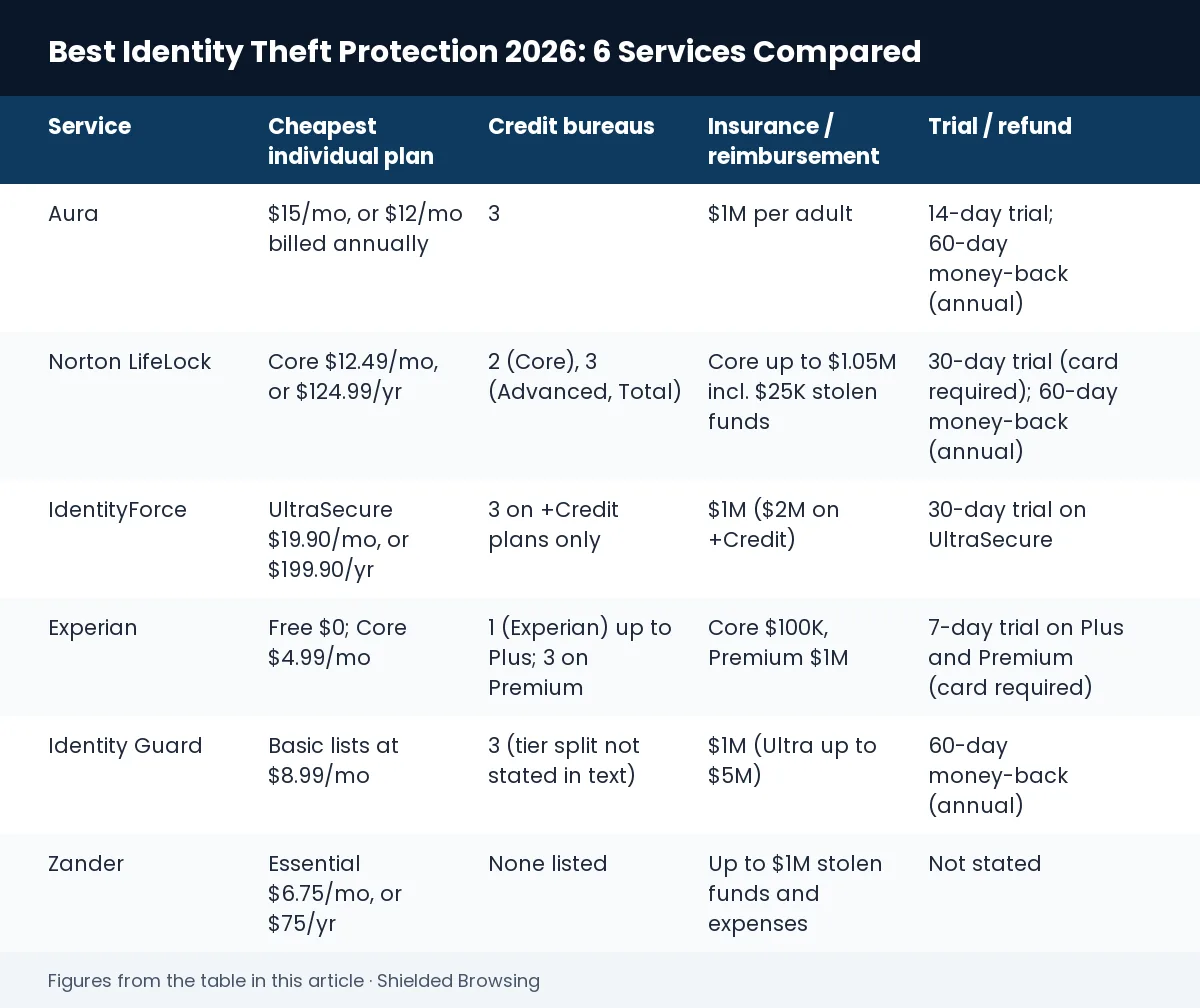
| Service | Cheapest individual plan | Credit bureaus | Insurance / reimbursement | Trial / refund |
|---|---|---|---|---|
| Aura | $15/mo, or $12/mo billed annually | 3 | $1M per adult | 14-day trial; 60-day money-back (annual) |
| Norton LifeLock | Core $12.49/mo, or $124.99/yr | 2 (Core), 3 (Advanced, Total) | Core up to $1.05M incl. $25K stolen funds | 30-day trial (card required); 60-day money-back (annual) |
| IdentityForce | UltraSecure $19.90/mo, or $199.90/yr | 3 on +Credit plans only | $1M ($2M on +Credit) | 30-day trial on UltraSecure |
| Experian | Free $0; Core $4.99/mo | 1 (Experian) up to Plus; 3 on Premium | Core $100K, Premium $1M | 7-day trial on Plus and Premium (card required) |
| Identity Guard | Basic lists at $8.99/mo | 3 (tier split not stated in text) | $1M (Ultra up to $5M) | 60-day money-back (annual) |
| Zander | Essential $6.75/mo, or $75/yr | None listed | Up to $1M stolen funds and expenses | Not stated |
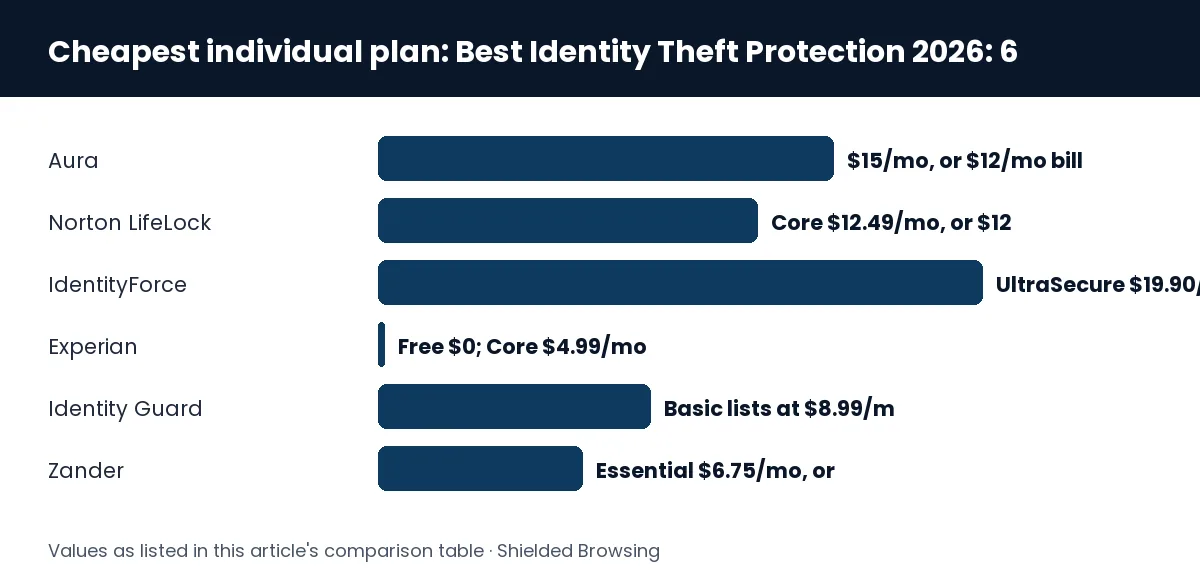
US dollars, read on each company’s own page on November 9, 2026 (IdentityForce and Zander’s yearly price: November 7). “Billed annually” means the monthly figure is charged as one yearly payment.
Aura: best overall for families
Aura bundles credit, identity and online-safety monitoring under one subscription, and its plan structure is the clearest of the group: every adult plan includes 3-bureau credit monitoring, and the price steps up by how many people you cover.
- Individual (1 adult): $15 a month, or $12 a month billed annually.
- Couple (2 adults): $29 a month, or $22 billed annually.
- Family (5 adults, unlimited kids): $50 a month, or $32 billed annually.
- Kids: $13 a month, or $10 billed annually.
Aura says every adult on a plan is “backed by a $1,000,000 insurance policy to cover eligible losses and fees.” Its Instant Credit Lock covers your Experian file only, so for the other two bureaus you would still place your own freeze. The Family plan adds a 3-bureau credit freeze for children. There is a 14-day free trial (once per customer), and annual plans bought on Aura’s own websites carry a 60-day money-back guarantee.
The catch: Aura’s pricing page lists no separate stolen-funds figure, and the lock is single-bureau. Its value is in covering a whole household at one price.
Norton LifeLock: best for stolen-funds coverage
LifeLock, now sold by Norton, is the only service here with a three-tier ladder where each step raises both monitoring and the stated reimbursement for stolen money.
- Core: $124.99 a year or $12.49 a month for 1 adult. 2-bureau credit monitoring. Up to $1.05M reimbursement, “with up to $25K for Stolen Funds.”
- Advanced: $199.99 a year or $19.99 a month. 3-bureau monitoring, up to $100K for stolen funds.
- Total: $349.99 a year or $34.99 a month. 3-bureau monitoring, up to $3M total with up to $1M for stolen funds.
Two-adult and family versions are available. Total for 2 adults and up to 10 kids is $749.99 a year. All three tiers include a “Credit & Payday Loan Lock.” LifeLock offers a 30-day free trial (its fine print says a card is required), and annual plans include a 60-day money-back guarantee. Its fine print also says prices are for an introductory term and renew at the standard price, so check the renewal figure at checkout.
The catch: Core monitors only two bureaus, and the big stolen-funds numbers sit on the expensive tiers. Read the terms on what counts as stolen funds (see the insurance section below).
IdentityForce: best for recovery help
IdentityForce, owned by TransUnion, leads with recovery: its homepage promises a “Personalized Action Plan,” a “Dedicated Restoration Specialist” and “Fully Managed Restoration.”
- UltraSecure (individual): $19.90 a month or $199.90 a year. $1M insurance. No credit monitoring listed.
- UltraSecure+Credit (individual): $34.90 a month or $349.90 a year. 3-bureau monitoring, daily TransUnion reports and scores, $2M insurance.
- Family versions: $24.90 and $39.90 a month.
UltraSecure plans offer a 30-day trial, after which you’re billed unless you cancel. We could not find refund terms on the pages we were able to read, so check them before you buy. These IdentityForce prices were read November 7, 2026.
The catch: credit monitoring only comes with the +Credit plans, which makes IdentityForce one of the pricier ways to get 3-bureau coverage.
Experian: best free or low-cost start
Experian, one of the three credit bureaus, sells its own protection tiers. Its pages no longer use the old “IdentityWorks” name; the plans are Free, Core, Plus and Premium.
- Free: $0, no credit card required. Experian credit report and monitoring.
- Core: $4.99 a month. Adds Experian CreditLock and up to $100K insurance.
- Plus: $14.99 a month. Up to $500K insurance.
- Premium: $24.99 a month. 3-bureau monitoring and up to $1M insurance.
Plus and Premium offer a 7-day free trial, which needs a credit card. You can cancel or downgrade to the free plan at any time. Experian lists these plans at monthly prices only, with no annual price on its comparison page, and offers a family version that adds a second adult and up to 10 children; the family price is not shown on that page.
The catch: every tier below Premium watches only Experian’s file. The free plan is a good first step, but it is not 3-bureau protection.
Identity Guard: low entry price
Identity Guard lists Basic at $8.99 a month, Standard at $19.99 and its top Ultra tier at $29.99 for one person. Family plans cover 5 adults and unlimited kids, from $14.99 a month. Annual plans carry first-year discounts and renew at the list price; Basic for one person, for example, renews at $107.88 a year.
Its plans list “3-Bureau Credit Monitoring,” an Experian credit lock and “$1 Million Identity Theft Insurance,” with up to $5M on Ultra. There’s no free trial, but annual plans bought on its websites or through support carry a 60-day money-back guarantee.
The catch: the plans page doesn’t spell out in text which tiers include 3-bureau monitoring, so confirm that on the plan card before buying the cheapest tier.
Zander: cheapest reimbursement plan
Zander takes a different approach. Its page says plainly: “This is not an insurance product. This is an administrative services contract.” What you buy is recovery services plus reimbursement “Up to $1,000,000 for Stolen Funds & Expenses” ($2M on family plans).
- Essential: $6.75 a month or $75 a year (individual); $12.90 a month or $145 a year (family).
- Elite: $11.99 a month or $130 a year (individual); $21.99 a month or $240 a year (family). Adds Experian CreditLock.
Family plans cover any two adults plus up to 10 children. The yearly, family and Elite prices above were read November 7, 2026; the $6.75 monthly Essential price was confirmed November 9.
The catch: Zander’s page lists no credit bureau monitoring. It suits someone who has already frozen their credit and wants recovery help and reimbursement as a backstop, at the lowest yearly cost.
Data-broker removal is a different job
Identity theft services watch for misuse of your information. Data-broker removal services shrink how much of it is for sale in the first place, by sending opt-out requests to people-search sites. The two overlap (LifeLock now advertises “Automatic Data Broker Removal”), but a dedicated removal service usually covers more sites.
Optery is the one we point to most often. Its free plan shows where you’re exposed, and paid plans run from $39 a year (Core, or $3.99 month to month) to $249 a year (Ultimate, or $24.99 month to month), with automated removals from 380+ sites on Core and 625+ on Ultimate, and a 30-day money-back guarantee. See Optery’s plans (affiliate link). For the full comparison, including DeleteMe and Incogni, read our best data removal services guide.
What “$1 million insurance” really covers
Almost every service here advertises a seven-figure policy, so read what it pays for. The FTC’s guidance is blunt: “Identity theft insurance generally won’t reimburse you for money scammers stole.” Most of these policies cover the costs of recovering your identity, such as lawyers, lost wages and fees, not the stolen money itself.
Some services now advertise reimbursement for stolen money as a separate benefit. On their own pages, Norton LifeLock lists up to $25K (Core), $100K (Advanced) or $1M (Total) “for Stolen Funds,” and Zander lists “Up to $1,000,000 for Stolen Funds & Expenses.” Aura, IdentityForce, Identity Guard and Experian list an insurance amount but no separate stolen-funds figure. Both points can be true at once: the general rule is that insurance doesn’t replace stolen money, and a few plans add a specific benefit that does, on their terms. If that matters to you, read the policy summary before you buy.
1-bureau vs 3-bureau monitoring
A lender may check any one of the three bureaus when someone applies for credit in your name. A service that watches only one file can miss an account opened on another. Experian’s Free, Core and Plus plans and LifeLock Core (2 bureaus) watch fewer than three; Aura, LifeLock Advanced and Total, IdentityForce +Credit and Experian Premium watch all three. A free credit freeze at all three bureaus covers the same gap, for nothing.
Who needs paid protection, and who doesn’t
- You probably don’t need it if you’ve frozen your credit at all three bureaus, check your reports and bank statements, and are comfortable handling recovery yourself through IdentityTheft.gov.
- It may be worth it if you’d rather have a specialist handle recovery, want alerts for things a freeze doesn’t cover, or are protecting several people. For a household, Aura’s Family plan is the simplest buy.
- For older relatives, the recovery help matters more than the alerts. Look for a named restoration specialist (IdentityForce) or full-service recovery, and set up the free credit freeze for them too.
- After a data breach notice, freeze your credit first. If the notice offers free monitoring, use that before paying for your own.
Strong account security matters as much as any of this. A password manager and a phishing-resistant second factor stop the account takeovers that monitoring only reports after the fact.
How we chose these services
We started from the best-known US identity theft services and ranked them on what a buyer can verify on each company’s own site on November 9, 2026 (IdentityForce and some Zander prices: November 7): price (monthly and annual), how many credit bureaus are monitored, credit lock, the stated insurance and stolen-funds amounts, and trial and refund terms. We did not use review sites for any figure and did not sign up for these services, so we make no claims about alert speed or support quality. Where a company’s page didn’t state something, we say so.
Frequently asked questions
Is identity theft protection worth it?
It can be, for convenience and recovery help, but the FTC notes you can do some of what these services offer yourself for little or no cost. A free credit freeze at all three bureaus is the most effective single step. Pay for a service if you want monitoring, alerts and recovery handled for you.
What is the best identity theft protection for families?
Aura’s Family plan covers 5 adults and unlimited kids for $32 a month billed annually, with 3-bureau monitoring and $1M insurance per adult. Norton LifeLock and Identity Guard also sell family plans, and Zander’s family plan is the cheapest at $145 a year, but it lists no credit monitoring.
What is the best identity theft protection for seniors?
For an older relative, recovery help matters most: IdentityForce advertises a dedicated restoration specialist, and Aura and LifeLock include recovery support. Whatever you choose, place a free credit freeze for them at all three bureaus too.
Can I protect myself from identity theft for free?
Yes, partly. Freeze your credit at Equifax, Experian and TransUnion (free, per the FTC), check your free weekly credit reports at AnnualCreditReport.com, and use IdentityTheft.gov if something happens. Experian’s free plan adds monitoring of your Experian file at no cost.
Does $1 million identity theft insurance pay back stolen money?
Usually not. The FTC says identity theft insurance generally won’t reimburse money scammers stole; it typically covers recovery costs. A few plans list a separate stolen-funds benefit, such as Norton LifeLock (up to $25K on Core, up to $1M on Total) and Zander. Read the terms before relying on it.
Aura or LifeLock: which is better?
Aura is simpler and cheaper for a household, with 3-bureau monitoring on every adult plan. LifeLock is the pick if you want a stated stolen-funds benefit, which reaches $1M on its Total plan, but its cheapest Core plan monitors only two bureaus.
Bottom line
Start with the free steps: freeze your credit at all three bureaus and check your weekly reports. If you then want a service to watch and recover for you, Aura is the best all-round value, especially for families. Choose Norton LifeLock Total for the largest stated stolen-funds benefit, IdentityForce for recovery help, Experian Free to try monitoring at $0, and Zander if you only want low-cost reimbursement and recovery. Check the renewal price at checkout, because several of these plans discount the first year only.