Best Antivirus for Windows of November 2026
This page has no affiliate links right now. Every vendor link below is a plain link, and we earn nothing if you buy. If that changes, this line will change with it. See our affiliate disclosure. Editorial placement is decided on merit and is not for sale.
The verdict: The best antivirus for most Windows PCs is Bitdefender Total Security, at $49.99 for the first year on five devices. The exact product it sells scored a perfect 18 of 18 at AV-TEST, 99.0% protection with just one false alarm in AV-Comparatives’ July to October 2026 Real-World test, and an Advanced+ award for low system impact. ESET runs it close and costs less. But start with the free one you already have. Microsoft Defender, built into Windows 10 and 11, scored 17.5 of 18 at AV-TEST and earned an AAA rating from SE Labs. A paid suite buys you a measurably better result in some tests and a bundle of extras. It does not buy you safety you would otherwise lack.
Prices, plans and device counts were read on each vendor’s own US pricing page on November 23, 2026. Several vendors were running Black Friday or Cyber Monday pricing that day, so first-year prices are likely to rise after the sale ends. Lab results come from AV-TEST (August 2026), AV-Comparatives (Real-World Protection, July to October 2026; Performance, September 2026) and SE Labs (Home Anti-Malware, July to September 2026), all linked below. We do not test antivirus products ourselves.
On this page
- The short list
- Comparison table
- How we picked
- 1. Bitdefender Total Security: best overall
- 2. Norton AntiVirus Plus: best real-world protection score
- 3. ESET HOME Security Essential: best for fewest false alarms
- 4. Avast Free Antivirus: best free alternative to Defender
- 5. Microsoft Defender: best built-in, no-cost baseline
- 6. Malwarebytes Standard: best for a second opinion
- Which one is right for you
- What Microsoft Defender already covers
- How to read the lab results
- The renewal problem, in dollars
- What didn’t make the list, and why
- What antivirus can’t do
- Frequently asked questions
- Bottom line
The short list
- Bitdefender Total Security: best overall, five devices for $49.99 in year one
- Norton AntiVirus Plus: best real-world protection score (100% at AV-Comparatives) and a 60-day money-back guarantee
- ESET HOME Security Essential: best for fewest false alarms (zero in AV-Comparatives’ Real-World test)
- Avast Free Antivirus: best free alternative, with 100% real-world protection and an SE Labs AAA
- Microsoft Defender: best no-cost baseline, already on your PC
- Malwarebytes Standard: best second-opinion scanner, but with more false alarms than the rest
Comparison table
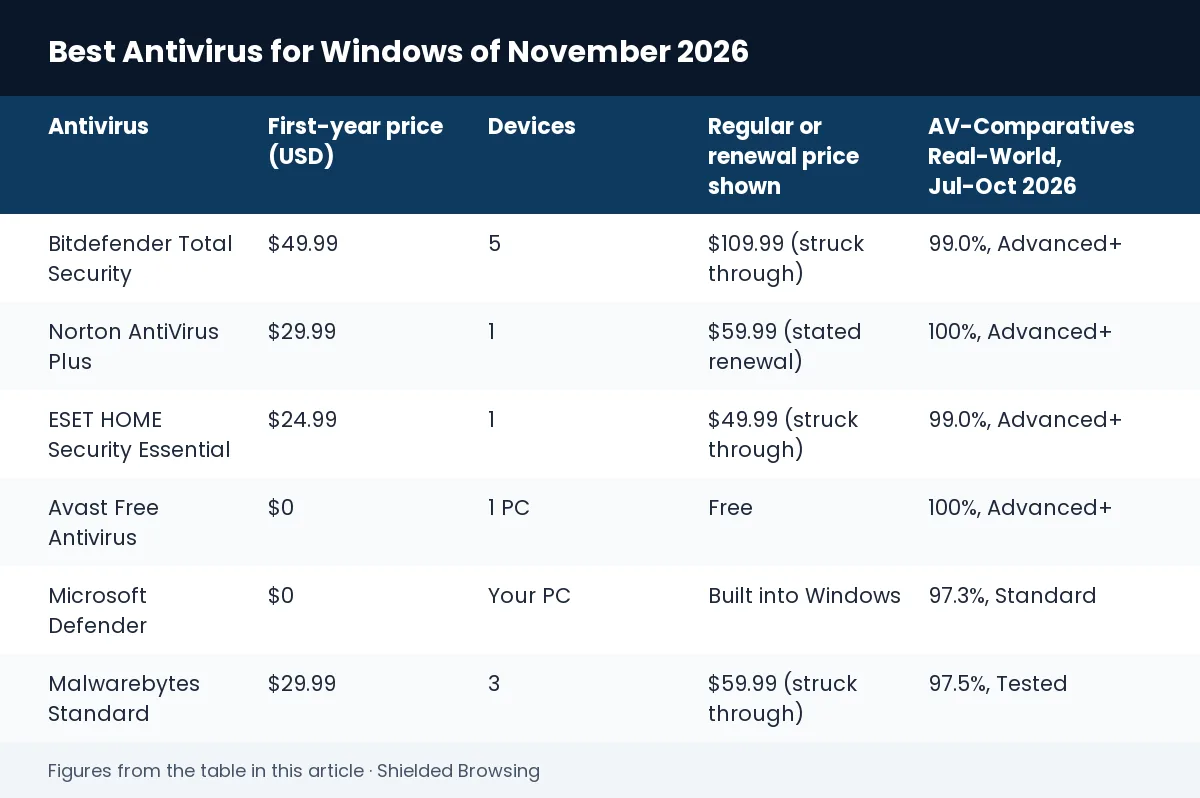
| Antivirus | First-year price (USD) | Devices | Regular or renewal price shown | AV-Comparatives Real-World, Jul-Oct 2026 | Link |
|---|---|---|---|---|---|
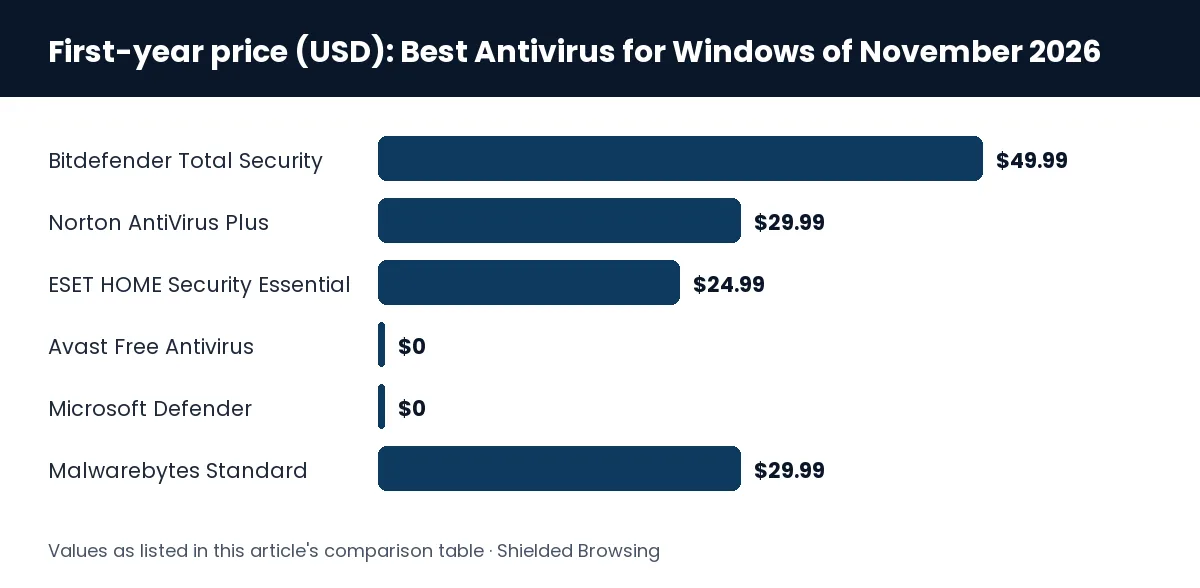
| Bitdefender Total Security | $49.99 | 5 | $109.99 (struck through) | 99.0%, Advanced+ | See plans → |
| Norton AntiVirus Plus | $29.99 | 1 | $59.99 (stated renewal) | 100%, Advanced+ | See plans → |
| ESET HOME Security Essential | $24.99 | 1 | $49.99 (struck through) | 99.0%, Advanced+ | See plans → |
| Avast Free Antivirus | $0 | 1 PC | Free | 100%, Advanced+ | Download → |
| Microsoft Defender | $0 | Your PC | Built into Windows | 97.3%, Standard | How to check it → |
| Malwarebytes Standard | $29.99 | 3 | $59.99 (struck through) | 97.5%, Tested | See plans → |
Prices are before sales tax. “Struck through” means the vendor shows that figure crossed out next to the sale price; only Norton and Avast print the word “renewal” next to it. The Real-World column is the AV-Comparatives protection rate and award for each vendor’s tested product (Avast One Free and Norton Antivirus Plus in Norton’s and Avast’s case). Awards include a penalty for false alarms, which is why Malwarebytes sits at “Tested” despite a 97.5% protection rate.
How we picked
We started from the 25 Windows consumer security vendors that appear in at least one of three current independent reports: AV-TEST’s August 2026 Windows 11 home-user table (15 products), AV-Comparatives’ Real-World Protection Test for July to October 2026 (20 products, 400 test cases) and SE Labs’ Home Anti-Malware report for July to September 2026 (11 products). We do not test antivirus products ourselves; every protection figure on this page is one of those labs’ published results, linked to the source.
To make the list, a product had to:
- Score a full 6 for protection at AV-TEST in August 2026, or be Microsoft Defender, which we include as the baseline everyone already has.
- Reach at least a 97% protection rate in AV-Comparatives’ July to October 2026 Real-World test.
- Be legally sold and updated in the US. That rules out Kaspersky, which scored well in all three labs but has been barred from selling or updating its antivirus for US customers since 2024 (details below).
- Have a US pricing page we could actually read today. McAfee’s pages refused every request we made on November 23, 2026, so McAfee is not ranked even though its lab results are strong. We would rather leave it out than print a price we did not see.
Among the products that passed, we ranked by the full lab picture first (protection, false alarms and system impact across all three labs), then by what you pay per device in year one and after it. We read each vendor’s pricing page and its renewal wording. Lab scores for a vendor’s flagship product do not automatically transfer to its cheaper plan, so each block below names exactly which product the labs tested.
1. Bitdefender Total Security: best overall
- Starting price: $49.99 first year for up to 5 devices (struck-through price $109.99); Antivirus Plus from $24.99 for 1 device
- Free tier: None for Windows on this page; 30-day refund on purchase and on automatic renewal
- Platforms: Windows, macOS, Android, iOS
- Notable limit: Bundled VPN capped at 200 MB a day per device
Why Bitdefender? It has top marks in every Windows test it entered this quarter, and both labs tested the same product it sells as its main plan. At AV-TEST in August 2026, Bitdefender Total Security 27.0 scored 6, 6 and 6 for protection, performance and usability. In AV-Comparatives’ Real-World Protection Test for July to October 2026 it blocked 396 of 400 attacks (99.0%) with one false alarm, the second-lowest count in the test, and earned Advanced+. In AV-Comparatives’ September 2026 Performance Test it also took Advanced+, with an impact score of 8.7 (lower is better). Several other products match one of those results. Only ESET matches all three, and ESET’s lab results are split across two different ESET products, while Bitdefender’s all come from Total Security. Bitdefender also covers iOS on the same five-device plan.
Value is the other half. On November 23, 2026, Total Security was $49.99 for five devices, about $10 a device. The single-device Antivirus Plus plan was $24.99, so Total Security is the better buy as soon as you have two devices. Bitdefender’s family plan covered up to 25 devices for $69.99 (struck-through $139.99).
What we like
- Perfect 18 of 18 at AV-TEST and Advanced+ in both AV-Comparatives tests on the same product.
- Only one false alarm in AV-Comparatives’ Real-World test.
- Five devices for about $10 each in year one.
- The 30-day refund window covers automatic renewals too, per Bitdefender’s terms.
Watch out for
- The renewal price is likely more than double. Bitdefender’s terms say any discount shown “describes the difference between the first term and renewal term subscription prices”, which points to about $109.99 a year after year one.
- Not in SE Labs’ Q3 2026 home report, so you get two labs’ verdicts here, not three.
- The VPN is a token extra: 200 MB a day per device on this plan.
Best for: anyone with two to five devices who wants the strongest all-round lab record per dollar.
Skip it if: you have one Windows PC and Defender or Avast Free already meets your needs.
See Bitdefender Total Security plans →
Read our full Bitdefender review →
2. Norton AntiVirus Plus: best real-world protection score
- Starting price: $29.99 first year for 1 device, renewing at $59.99; $39.99 for 5 devices, renewing at $84.99
- Free tier: None; 60-day money-back guarantee
- Platforms: Windows, macOS, Android, iOS
- Notable limit: No VPN or parental controls until you move up to Norton 360
Why Norton? In AV-Comparatives’ July to October 2026 Real-World test, Norton Antivirus Plus blocked all 400 attacks, a 100% protection rate shared only with Avast and AVG, which use the same engine. Norton 360 also scored 6/6/6 at AV-TEST in August 2026, and SE Labs gave Norton 360 an AAA rating with a 98% Total Accuracy Rating in its Q3 2026 Home Anti-Malware report. Its AV-Comparatives impact score of 4.9 was the fourth-lightest of 20.
The detail a spec sheet won’t give you is that Norton prints its renewal price. Every plan card on its pricing page says “Savings compared to the renewal price of” a stated figure. That makes the second-year cost easy to plan for. The step-up, Norton 360 Deluxe, was $49.99 in year one for five devices and renews at $124.99, and adds a VPN, 50 GB of cloud backup, a password manager and parental controls.
What we like
- A 100% protection rate in AV-Comparatives’ latest Real-World test.
- Renewal prices printed on the plan cards.
- A 60-day money-back guarantee, double the industry’s usual 30 days.
- Advanced+ for system impact in AV-Comparatives’ September 2026 Performance Test.
Watch out for
- Renewal doubles the price: $29.99 becomes $59.99, and 360 Deluxe goes from $49.99 to $124.99.
- Five false alarms in the Real-World test, against one for Bitdefender and zero for ESET.
- SE Labs’ protection accuracy was 95%, behind Avast (98%) and Defender (97%) in the same report.
Best for: a single Windows PC owner who wants a top real-world score and a long refund window.
Skip it if: you dislike upsell prompts for the 360 and LifeLock tiers.
See Norton AntiVirus Plus plans →
Compare Norton in our antivirus suite roundup →
3. ESET HOME Security Essential: best for fewest false alarms
- Starting price: $24.99 first year for 1 device (struck-through $49.99); $29.99 for 3; $34.99 for 5
- Free tier: 30-day free trial
- Platforms: Windows, macOS, Android, iOS (per ESET’s store page)
- Notable limit: Renewal price is not stated on the store page
Why ESET? False alarms are the hidden cost of antivirus: a tool that blocks a legitimate installer or a harmless website teaches you to click past its warnings. In AV-Comparatives’ July to October 2026 Real-World test, ESET HOME Security Essential produced zero false positives while still blocking 396 of 400 attacks (99.0%, Advanced+). It also took Advanced+ in the September 2026 Performance Test, and ESET Security Ultimate scored 6/6/6 at AV-TEST in August 2026.
ESET’s pricing is the most granular here. Its store lets you choose any device count from 1 to 10 on Essential, priced in steps of $2.50 a device during the current CYBER2026 promotion. Five devices cost $34.99 in year one, less than Bitdefender’s $49.99 for the same count, which makes it the cheapest five-device option on this list on today’s prices.
What we like
- Zero false alarms in AV-Comparatives’ latest Real-World test.
- The cheapest five-device first-year price on this list ($34.99).
- Pay for exactly the number of devices you have.
- A 30-day free trial before you pay.
Watch out for
- The struck-through price is double ($69.99 for five devices), and the store page we read does not state the renewal price, so check it at checkout.
- The lab-tested product names vary: AV-TEST tested Security Ultimate, AV-Comparatives tested Security Essential.
- Not in SE Labs’ Q3 2026 home report.
Best for: people who are tired of false warnings, and households with an odd number of devices.
Skip it if: you want a VPN or identity tools in the base plan.
See ESET HOME Security plans →
4. Avast Free Antivirus: best free alternative to Defender
- Starting price: Free; Avast Premium Security $49.08 first year for 1 PC (renews at $77.99), $69.48 for 10 devices (renews at $99.99)
- Free tier: Yes, for one Windows PC
- Platforms: Windows (free); Premium adds macOS, Android, iOS
- Notable limit: The free app may prompt you to reactivate after 12 months
Why Avast Free? Because the lab numbers do not support the idea that free means weaker. In AV-Comparatives’ July to October 2026 Real-World test, Avast One Free blocked all 400 attacks, the joint-best result. SE Labs gave Avast Free Antivirus an AAA with 98% protection accuracy and a 99% Total Accuracy Rating. AV-TEST scored Avast Free Antivirus 6/6/6 in August 2026, and its AV-Comparatives impact score of 5.2 earned Advanced+.
The honest catch is the business model. A free product has to pay for itself somehow, and Avast does it with upgrade prompts. Avast’s own FAQ also says “After 12 months, our app might prompt you to reactivate your free subscription”. If you install it, expect to see offers for Premium Security, and decline the bundled extras you did not ask for during setup.
What we like
- 100% real-world protection at no cost.
- SE Labs AAA and AV-TEST 18 of 18.
- Light on system resources, per AV-Comparatives.
- Premium Security, if you upgrade, prints its renewal price.
Watch out for
- Upgrade prompts and optional add-ons come with the free app.
- Five false alarms in the Real-World test, more than Defender’s one.
- Premium’s 10-device plan renews at $99.99, up from $69.48.
Best for: anyone who wants a second free option with stronger lab scores than Defender in AV-Comparatives’ test.
Skip it if: you prefer software that never tries to sell you anything; Defender does not.
Download Avast Free Antivirus →
5. Microsoft Defender: best built-in, no-cost baseline
- Starting price: $0, built into Windows 10 and 11
- Free tier: It is the free tier
- Platforms: Windows; Microsoft 365 Personal and Family add a Microsoft Defender app for Windows, Mac, iOS and Android
- Notable limit: Switches itself off when you install another antivirus
Why Defender? Because it is already running, and the labs rate it well. Microsoft’s Windows Security page says the app includes Microsoft Defender Antivirus, Windows Firewall and Smart App Control, and that Defender “continuously scans your device for potential threats”. At AV-TEST in August 2026 it scored 6 for protection, 6 for usability and 5.5 for performance: 17.5 of 18. SE Labs gave it an AAA, with 97% protection accuracy and a 99% Total Accuracy Rating, higher than Norton 360 in the same report.
The weaker result is AV-Comparatives. Defender blocked 389 of 400 attacks (97.3%) in the July to October 2026 Real-World test, which put it in the third cluster and earned a Standard award, against Advanced+ for every paid product above it. Its September 2026 impact score of 13.5 was 11th of 20 (Advanced). So the fair summary is: good protection, slightly behind the best paid tools in one of three labs, and a little heavier on system performance.
What we like
- No cost, no install, no upsell, no renewal date.
- SE Labs AAA and 17.5 of 18 at AV-TEST.
- Only one false alarm in AV-Comparatives’ Real-World test.
Watch out for
- 97.3% and a Standard award in AV-Comparatives’ latest Real-World test, the lowest on this list.
- Half a point lost on performance at AV-TEST, and 11th of 20 for system impact at AV-Comparatives.
- Make sure it is actually on. Microsoft’s documentation says Defender goes into disabled mode automatically when another antivirus is the primary one. If you uninstall a paid product, check that Defender is back.
Best for: one careful user on one up-to-date Windows PC.
Skip it if: you want the very top protection cluster in AV-Comparatives’ testing, or extras such as a family plan for many devices.
6. Malwarebytes Standard: best for a second opinion
- Starting price: $29.99 first year for 3 devices (struck-through $59.99); Plus with VPN $39.99 (struck-through $79.99)
- Free tier: Free scanner listed among Malwarebytes’ free tools
- Platforms: Windows, macOS, Android, iOS
- Notable limit: Most false alarms of any product on this list
Why Malwarebytes? It has a long reputation as the tool people run when something already feels wrong, and its free scanner still fills that role alongside Defender. Malwarebytes Premium scored 6/6/6 at AV-TEST in August 2026 and had 98% protection accuracy at SE Labs, level with Avast and above Defender and Norton.
The reason it sits last is false alarms. In AV-Comparatives’ July to October 2026 Real-World test, Malwarebytes Premium had 23, the second-highest count after Trend Micro’s 45, and was downgraded from its 97.5% protection rate to a “Tested” award. SE Labs said much the same thing in its Q3 report: “Only Malwarebytes Premium blocked or restricted access to a few legitimate objects”, which cut its legitimate accuracy to 92% and its award to AA. As your only real-time protection, that means more interruptions. As an on-demand second opinion, it is still useful.
What we like
- 18 of 18 at AV-TEST in August 2026.
- 98% protection accuracy at SE Labs.
- Three devices on the cheapest paid plan.
- A 60-day money-back guarantee, per its pricing page.
Watch out for
- 23 false alarms at AV-Comparatives and a “Tested” award as a result.
- The struck-through price is double and the page we read does not name it as the renewal price.
- Heavier on the PC: impact score 19.1 at AV-Comparatives, 14th of 20.
Best for: running a second scan alongside Defender when you suspect an infection.
Skip it if: you want a set-and-forget main antivirus with few warnings.
Which one is right for you
One Windows PC, careful habits, no budget: stay with Microsoft Defender, make sure Windows updates are on, and add a password manager. If you want a second free opinion now and then, run a Malwarebytes free scan.
One Windows PC, want the top real-world score: Norton AntiVirus Plus at $29.99 for the first year, or Avast Free if you are happy to see upgrade offers in exchange for paying nothing.
Two to five devices, Windows plus phones or a Mac: Bitdefender Total Security at $49.99, or ESET HOME Security Essential at $34.99 for five if false alarms are your main irritation.
A big household: Bitdefender’s family plan covers up to 25 devices for $69.99 in year one; Avast Premium Security covers 10 for $69.48.
You suspect you are already infected: disconnect from the internet, run a full Defender scan and a Malwarebytes scan, then change your important passwords from a different, clean device.
What Microsoft Defender already covers
Before paying for anything, it is worth knowing what is already on your PC. Per Microsoft’s support page, Windows Security bundles real-time antivirus scanning (Microsoft Defender Antivirus), Windows Firewall and Smart App Control in one app that is “built into Windows”. You can right-click any file and choose “Scan with Microsoft Defender”, and run quick or full scans from the Virus and threat protection screen.
What it does not give you on a standard Windows install is the bundle around the antivirus: a multi-device subscription covering phones and Macs, parental controls, a bundled VPN, cloud backup or identity monitoring. Microsoft offers a separate Microsoft Defender app for Windows, Mac, iOS and Android to Microsoft 365 Personal and Family subscribers, per the same support page.
One technical point catches people out. Microsoft’s compatibility documentation says that on Windows 10 and 11, when a non-Microsoft antivirus is your primary product, Defender Antivirus moves to “Disabled mode (happens automatically)”. You do not run both at once. That is fine while the paid product is installed and current. It becomes a problem when a paid subscription lapses: an expired third-party antivirus can leave you less protected than Defender would. If you let a subscription end, uninstall the product and confirm Defender has switched back on under Windows Security.
How to read the lab results
The three labs measure different things, and a product can top one and trail in another.
AV-TEST scores each product out of 6 for protection, performance and usability, 18 in total. In its August 2026 Windows 11 round it evaluated 15 products during July and August at default settings. Twelve scored a perfect 18, including Avast, Bitdefender, ESET, Malwarebytes, McAfee and Norton. Microsoft Defender and TotalAV lost half a point on performance; SpyHunter lost half a point on protection. With most products at the ceiling, AV-TEST tells you who is good, not who is best.
AV-Comparatives’ Real-World Protection Test exposes each product to live malicious URLs and counts how often the PC ends up compromised. The July to October 2026 report, released November 16, 2026, used 400 test cases on fully patched Windows 11. Results were grouped into clusters: Avast, AVG and Norton blocked all 400; Bitdefender, ESET, F-Secure and McAfee blocked 396; Microsoft blocked 389. Awards are then cut for products with above-average false alarms, which is why Malwarebytes dropped to “Tested”. AV-Comparatives notes that it considers products within a cluster “equally effective”.
AV-Comparatives’ Performance Test measures how much a product slows common tasks. In September 2026 the lightest was McAfee (impact score 3.1); Norton (4.9), Avast (5.2), Bitdefender (8.7) and ESET (9.5) all earned Advanced+; Defender (13.5) and Malwarebytes (19.1) earned Advanced.
SE Labs combines protection against public and targeted attacks with how accurately a product handles legitimate software into a Total Accuracy Rating. In its July to September 2026 Home Anti-Malware report, McAfee, Kaspersky and Sophos scored 100%, Avast and Defender 99%, Norton 98%, and Malwarebytes 94%. Bitdefender and ESET were not in that report.
The practical reading: every product on this list is well above the line. The differences between them are a handful of test cases out of hundreds. Pick on false alarms, system impact, device count and the renewal bill before you pick on a one-point protection gap.
The renewal problem, in dollars
Almost every paid antivirus price you see is a first-year price. Here is what each paid pick showed as its regular or renewal figure on November 23, 2026:
- Bitdefender Total Security, 5 devices: $49.99 now, $109.99 struck through. Bitdefender’s terms say the discount compares the first term with the renewal term.
- Norton AntiVirus Plus, 1 device: $29.99 now, renewal stated as $59.99.
- Norton 360 Deluxe, 5 devices: $49.99 now, renewal stated as $124.99.
- ESET HOME Security Essential, 5 devices: $34.99 now, $69.99 struck through; renewal not stated on the store page.
- Avast Premium Security, 1 PC: $49.08 now, renewal stated as $77.99.
- Malwarebytes Standard, 3 devices: $29.99 now, $59.99 struck through; renewal not stated on the pricing page.
Two habits save most of the money. First, put a reminder in your calendar a month before renewal and compare the renewal quote with the new-customer price; Bitdefender and Norton both say they email you before charging. Second, know the refund window: 30 days for Bitdefender (including after an automatic renewal, per its terms), 60 days for Norton and Malwarebytes, and 30 days for Avast Premium Security, per each vendor’s page.
What didn’t make the list, and why
McAfee Total Protection. On the lab evidence it belongs near the top: 6/6/6 at AV-TEST, 99.0% and Advanced+ at AV-Comparatives, the lightest system impact in September 2026 and a 100% Total Accuracy Rating at SE Labs. We left it unranked only because McAfee’s US pricing page refused every request we made on November 23, 2026, so we could not read its plans, device counts or renewal price. We will add it when we can source those numbers.
Kaspersky Premium. Strong in all three labs, but the US Commerce Department’s Bureau of Industry and Security prohibited Kaspersky from new US sales from July 20, 2024 and from providing antivirus signature and codebase updates to US customers from September 29, 2024. Antivirus without updates is not protection, so it is not an option for US readers.
TotalAV Premium. It lost half a point on performance at AV-TEST, earned only a Standard award with the third-heaviest impact score (30.5) in AV-Comparatives’ Performance Test, and had 81% protection accuracy at SE Labs, the lowest of the 11 products in that report.
G DATA, Trend Micro, K7, Panda and Quick Heal. All were downgraded in AV-Comparatives’ Real-World awards for above-average false alarms, and Quick Heal’s protection rate was 87.0%.
What antivirus can’t do
Antivirus blocks malicious files and websites. It cannot stop you from typing your password into a convincing fake login page that is not yet on a blocklist, reading a code to a caller who claims to be your bank, or reusing one password across every site. The biggest gains for most people are a password manager (see our best password managers), two-factor authentication with a hardware key on your email and bank accounts (see best hardware security keys), automatic Windows updates and an offline backup.
Antivirus also does nothing about your personal details on data-broker sites (see best data removal services) or about an out-of-date router (see how to secure your home network). And the small VPNs bundled with suites are not a privacy plan; read why free and capped VPNs deserve caution before relying on one.
Frequently asked questions
Is Microsoft Defender good enough for Windows 11?
For many people, yes. It scored 17.5 of 18 at AV-TEST in August 2026 and earned an SE Labs AAA in July to September 2026. It trailed the paid products in AV-Comparatives’ latest Real-World test (97.3% versus 99% to 100%), so paid suites have an edge there.
What is the best free antivirus for Windows?
On the current lab results, Avast Free Antivirus: 100% in AV-Comparatives’ July to October 2026 Real-World test, 18 of 18 at AV-TEST and an SE Labs AAA. Microsoft Defender is the other strong free option and needs no install.
Can I run two antivirus programs at once?
Not as two real-time scanners. Microsoft says Defender switches to disabled mode automatically when another antivirus is primary. Running an on-demand scanner, such as the free Malwarebytes scan, alongside one real-time product is a common approach.
Which antivirus slows Windows down the least?
In AV-Comparatives’ September 2026 Performance Test, McAfee had the lowest impact score (3.1), then K7, Kaspersky, Norton (4.9) and Avast (5.2). Bitdefender (8.7) and ESET (9.5) also earned Advanced+. Defender scored 13.5.
How much does antivirus cost after the first year?
Usually about double. On November 23, 2026, Norton AntiVirus Plus was $29.99 renewing at $59.99, and Bitdefender Total Security was $49.99 with $109.99 struck through. Check the renewal figure before you buy.
Is Kaspersky still available in the US?
No. The Bureau of Industry and Security barred new US sales from July 20, 2024 and antivirus updates to US customers from September 29, 2024.
Do I need antivirus if I’m careful online?
You need something running, and Defender already is. Careful habits stop most scams; real-time scanning catches what slips past, such as a malicious download from a site that looked legitimate.
Bottom line
If you have several devices, buy Bitdefender Total Security: strong results across both labs that tested it, one false alarm, and five devices for $49.99 in year one. If you have one PC, Norton AntiVirus Plus has the best real-world score at $29.99, and Avast Free matches that score for nothing. If you do nothing at all, Microsoft Defender is already protecting you to an AAA standard. Whatever you pick, note the renewal price and set a reminder.
Prices and plans read on each vendor’s US page on November 23, 2026; lab results from AV-TEST (August 2026), AV-Comparatives (Real-World July to October 2026, Performance September 2026) and SE Labs (Home Anti-Malware July to September 2026). Check the vendor’s page on the day you buy. L.H.
This page is for information, not security or legal advice.
About the author
Lennit Herrera is the founder and editor of Shielded Browsing. Every review here is researched and published by one named, accountable person. We do not run hands-on lab tests. Figures come from providers’ published material or named third-party sources, and each is dated. Corrections are welcome at hello@shieldedbrowsing.com. More about Shielded Browsing →